
Lung Cancer Surgery
Book an Appointment
Lung Cancer Surgery in Hyderabad: VATS, Uniportal VATS & Robotic Options
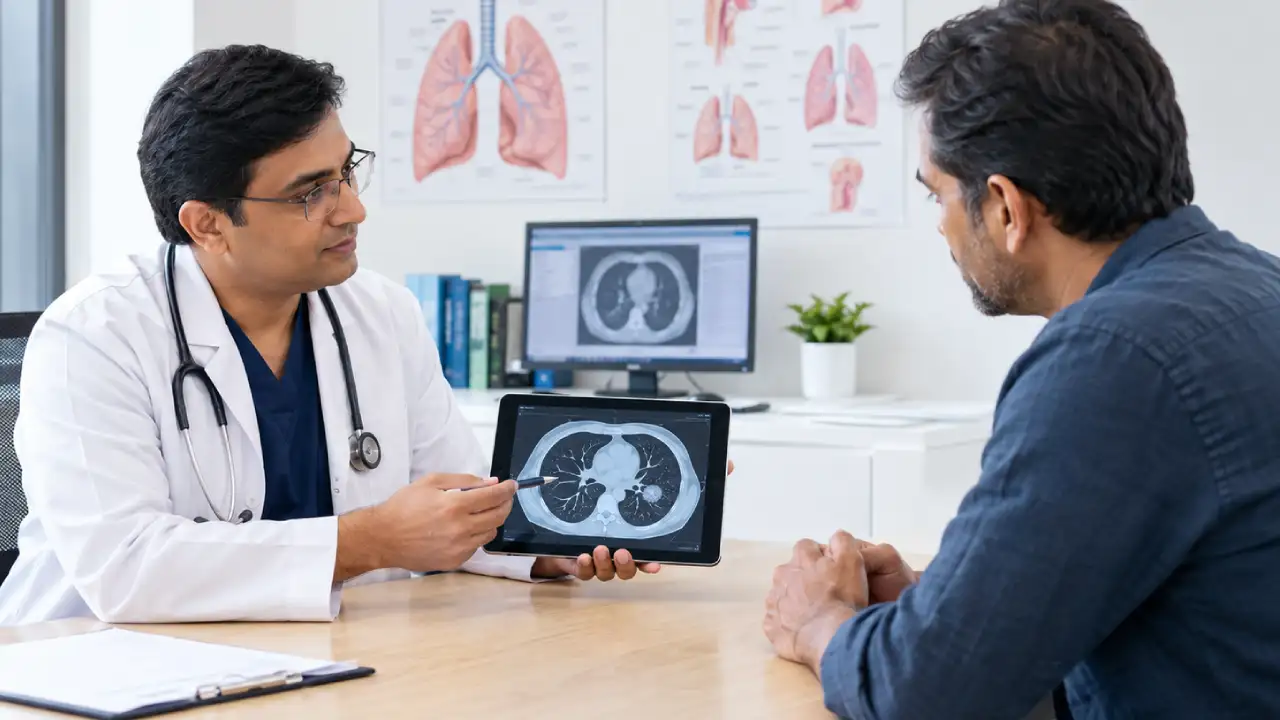
A lung nodule identified on a CT scan can raise several important questions. Is it cancer? Does it require a biopsy or surgery? If surgery is recommended, how much of the lung needs to be removed?
The appropriate next step depends on several factors, including the appearance of the nodule on imaging, whether it has changed over time, biopsy results when available, lymph node findings, lung function and overall health. Many lung nodules are benign, and not every nodule requires surgery.
At Apollo Cancer Centres, Jubilee Hills, Hyderabad, Dr. Ajesh Raj Saksena, MS (General Surgery), DrNB (Surgical Oncology), FMAS, FALS-Oncology, Senior Consultant Surgical Oncologist, evaluates patients with suspicious lung nodules and lung cancer to determine whether surgery may be appropriate and which surgical approach may best suit their condition.
When May Surgery Be Considered for Lung Cancer?
Surgery is one of the treatment options for selected lung cancers, particularly when the disease can be removed safely and completely.
Depending on the stage and characteristics of the cancer, treatment may also involve:
- Chemotherapy
- Immunotherapy
- Radiation therapy
- Surgery
- A combination of treatments
Before recommending surgery, the patient’s CT scans and other investigations are reviewed along with:
- Tumour size and location
- Lymph node findings
- Biopsy or pathology reports, when available
- Lung and heart function
- Overall fitness for surgery
Depending on the individual case, investigations such as PET-CT, bronchoscopy, biopsy or other tests may be required.
The goal of surgery is to remove the cancer with an appropriate margin, assess the lymph nodes and preserve as much healthy lung tissue as safely possible.
Types of Lung Surgery
The type and extent of lung surgery depend on the tumour’s size, location and behaviour, cancer stage, lymph node findings and the amount of lung function that can safely be preserved.
For selected centrally located tumours, this approach may preserve the remaining lung instead of requiring removal of the entire lung.
The amount of lung removed and the surgical approach are separate decisions. Choosing a minimally invasive or robotic technique does not by itself determine which type of lung resection is appropriate.
VATS, Uniportal VATS & Robotic Lung Surgery
VATS Surgery
Video-Assisted Thoracoscopic Surgery (VATS) is a minimally invasive technique in which a camera and surgical instruments are introduced through small incisions in the chest.
Multiport VATS uses several small incisions, while Uniportal VATS uses a single incision for the camera and surgical instruments.
Compared with open thoracotomy, VATS generally involves smaller incisions. Recovery and post-operative discomfort can vary depending on the operation, pain-management plan and the patient’s overall health.
Uniportal VATS
Uniportal VATS allows the surgeon to perform thoracic procedures through a single incision.
For selected patients and procedures, it may offer advantages such as reduced early post-operative pain compared with multiport VATS. However, outcomes vary between patients and it is not suitable for every operation.
Robotic-Assisted Thoracic Surgery
Robotic-Assisted Thoracic Surgery (RATS) is another minimally invasive approach.
The surgeon controls the robotic instruments from a console. The robot does not operate independently. The system provides a magnified three-dimensional view and articulated instruments that can assist with precise surgical movements.
Which Approach Is Appropriate?
Uniportal VATS, multiport VATS and robotic surgery each have a role in lung cancer surgery.
There is no single surgical approach that is appropriate for every patient or tumour.
An open operation may be recommended when the tumour’s location or extent, previous treatment or other patient-specific factors make it a safer or more suitable option.
The surgical approach should be selected after considering the expected benefits, limitations and risks for the individual patient.
Professional Development in Shanghai & Lanzhou
Dr. Ajesh Raj Saksena’s recent professional development included participation in the 58th International Uniportal VATS and RATS Program at Shanghai Pulmonary Hospital, a high-volume centre for thoracic surgery.
The programme covered uniportal and robotic approaches to lung resections, including:
- Wedge resection
- Anatomical segmentectomy
- Lobectomy with lymph node dissection
- Selected sleeve procedures
This experience contributes to discussions around surgical approach, extent of resection and lymph node assessment, while recommendations remain based on each patient’s scans, cancer stage, lung function and treatment goals.
An academic visit to the First Hospital of Lanzhou University focused on perioperative care, including surgical navigation, Enhanced Recovery After Surgery (ERAS), connected monitoring and rehabilitation.
Who Should Seek a Surgical Opinion?
A surgical consultation may be useful if:
- A CT scan has identified a new, growing or suspicious lung nodule.
- You have been diagnosed with lung cancer and want to understand whether surgery may be an option.
- Surgery has been recommended and you want to discuss the type and extent of resection.
- You have been advised to undergo a lobectomy and want to understand whether a lung-sparing procedure may be suitable.
- You have multiple lung nodules, a previous cancer diagnosis or reduced lung function.
- You would like a second opinion before deciding on treatment.
A consultation does not necessarily mean that surgery will be recommended.
Patients are encouraged to bring available CT or PET-CT images, scan reports, biopsy or pathology reports, lung-function test results and details of previous cancer treatment.
Why Choose Dr. Ajesh Raj for Head & Neck Cancer Treatment
Dr. Ajesh Raj Saksena provides individualised surgical evaluation for patients with suspicious lung nodules and lung cancer, with attention to cancer removal, lymph node assessment and preservation of lung function where appropriate.
His professional development in Uniportal VATS and robotic thoracic surgery, along with experience in surgical oncology, supports a personalised approach to selecting the appropriate surgical technique for each patient.
Frequently Asked Questions.
-
No. Many lung nodules are benign. Whether follow-up imaging, biopsy or surgery is appropriate depends on factors such as the nodule’s appearance, size, growth and the patient’s medical history.